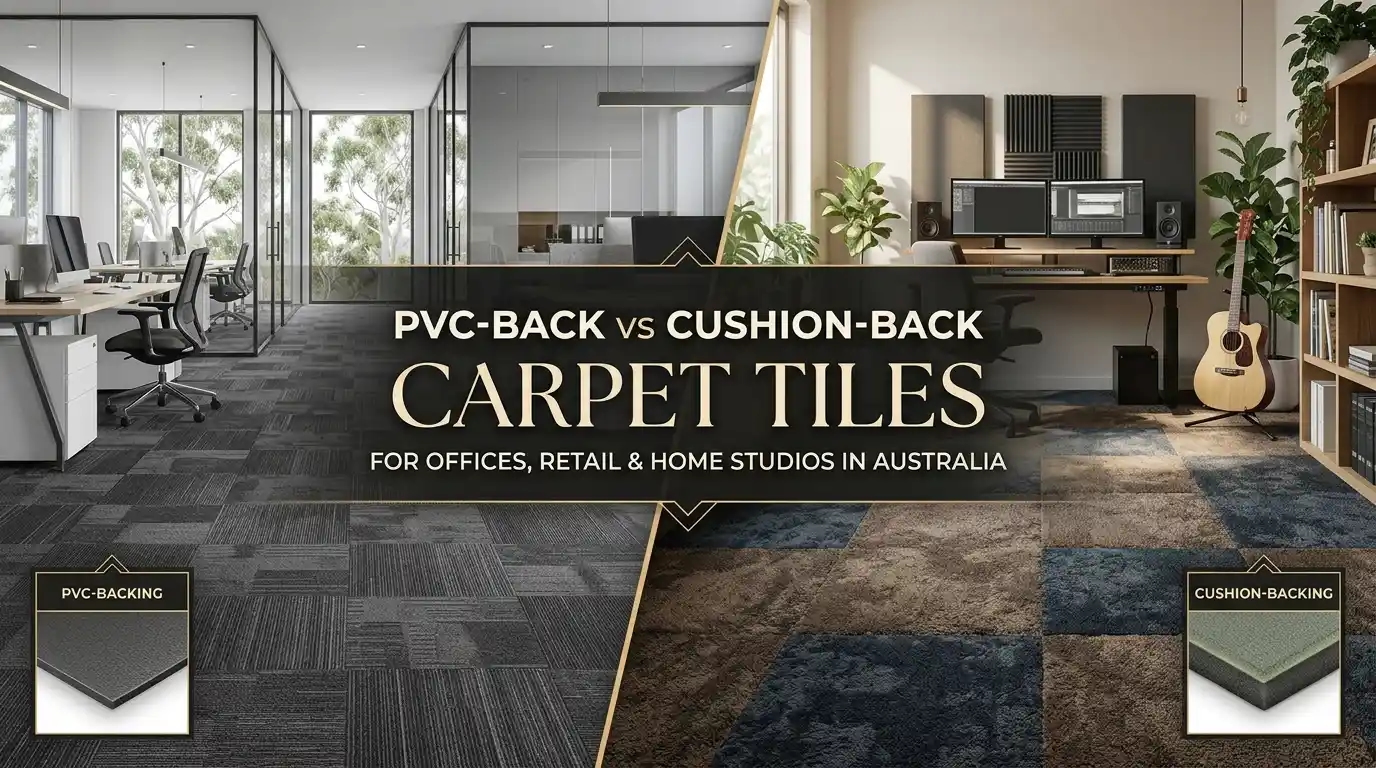
PVC-Back vs Cushion-Back Carpet Tiles for Offices, Retail & Home Studios in Australia
The wrong carpet tile backing can affect more than the look of your floor. It can change underfoot comfort, noise levels, floor stability and long-term performance. PVC-backed and cushion-backed carpet tiles offer different benefits, so choosing the right construction matters for busy offices, retail spaces and home studios.
In this blog, we compare PVC-back vs cushion-back carpet tiles in Australia, focusing on their construction, durability, comfort, acoustic performance, maintenance and installation. You'll learn how each backing performs in different environments, what to consider before buying and which option best suits your space, usage and budget.
In this blog
- What Is the Difference Between PVC-Back and Cushion-Back Carpet Tiles?
- How Do PVC and Cushion-Back Carpet Tiles Compare in Performance?
- Which Carpet Tile Backing Is Better for Offices, Retail and Home Studios?
- How Do PVC and Cushion-Back Carpet Tiles Compare in Installation?
- How Much Do PVC-Back and Cushion-Back Carpet Tiles Cost in Australia?
- How Do You Maintain and Clean PVC-Back and Cushion-Back Carpet Tiles?
- How Should You Choose the Right Carpet Tile Backing?
- Conclusion
- FAQS
What Is the Difference Between PVC-Back and Cushion-Back Carpet Tiles?
The main difference between PVC-back and cushion-back carpet tiles is the material and structure beneath the carpet surface. PVC-backed tiles use a firm backing system that supports the carpet and helps maintain dimensional stability, while cushion-backed tiles include a resilient layer designed to improve underfoot comfort and absorb impact sound. These construction differences affect the tile's thickness, weight, feel and suitability for different spaces.
Both backing types are available in commercial carpet tile ranges across Australia. However, their performance depends on the materials, backing design, carpet pile and product specifications. Understanding how each construction works helps you choose carpet tiles that meet the practical needs of offices, retail stores and home studios.
Explore Carpet TilesWhat Are PVC-Back Carpet Tiles?
PVC-back carpet tiles use a firm polyvinyl chloride (PVC) backing beneath the carpet pile and primary backing. This vinyl-based layer supports the carpet structure, helps the tile retain its shape and provides a stable base for installation.
Manufacturers may combine PVC compounds with reinforcing materials, such as fibreglass, to improve dimensional stability. Some products also use recycled content in their backing. The exact formulation varies between manufacturers, so PVC-backed tiles do not all have the same construction or weight.
PVC backing creates a relatively firm feel underfoot compared with a cushioned backing. This construction can suit offices, retail spaces and other commercial interiors where a stable carpet tile is important. However, buyers should still check the product's suitability for rolling chairs, heavy foot traffic and the intended installation method.
What Are Cushion-Back Carpet Tiles?
Cushion-back carpet tiles include a resilient layer beneath the carpet structure that provides additional cushioning. Unlike a traditional firm PVC hardback, this construction adds a softer layer that can improve underfoot comfort and help absorb impact sound.
Manufacturers use different materials to create this cushioning. Some products incorporate foam-based layers, while others use recycled PET or other resilient materials. The backing may also include reinforcement layers to support the tile and maintain its shape.
Cushion-backed tiles can be useful in offices, retail environments and home studios where people spend long periods standing or walking. Their cushioning can also contribute to acoustic comfort by reducing impact noise. However, the level of comfort and sound absorption depends on the specific backing construction and its tested performance, not simply the cushion-back label.
How Are PVC and Cushion Backing Materials Constructed?
PVC and cushion backing systems use different materials and layer arrangements to support the carpet surface. PVC-backed products commonly use a vinyl-based compound, sometimes reinforced with fibreglass. Cushion-backed products may use foam, recycled PET or other resilient materials, depending on the manufacturer's design.
A typical carpet tile contains several layers:
Carpet pile: The visible surface, usually made from nylon, polypropylene or another carpet fibre.
Primary backing: The textile layer that holds the tufted carpet yarn in position.
Reinforcement layer: Some products include fibreglass or another stabilising material to support the tile structure.
Secondary backing: The PVC or cushion-based layer that provides support, stability or cushioning.
How Does Carpet Tile Backing Affect Overall Thickness and Weight?
Carpet tile backing affects the finished tile's total thickness and weight, but the carpet pile also contributes to both measurements. Buyers should compare pile height, backing thickness, total product thickness and total weight per square metre rather than judging a tile by its backing type alone.
Pile height measures the height of the carpet fibres above the primary backing. Backing thickness refers to the supporting or cushioning layers beneath the carpet. Total thickness measures the complete tile, while total weight indicates the mass of the finished product, usually expressed in kilograms per square metre.
Can the Same Carpet Tile Design Come With Different Backing Options?
Yes, some manufacturers offer the same carpet tile design or colour range with different backing options. This allows buyers to select a construction that suits their space without changing the overall carpet appearance.
This flexibility helps businesses maintain a consistent colour scheme across different areas while choosing backing systems according to their functional needs. During laying carpet tiles, an office may use a firm-backed option in areas with rolling chairs and a cushion-backed version in spaces where staff spend more time standing.
However, do not assume that every colour, pattern or product is available with both backing types. Confirm availability, technical specifications, installation requirements and warranty conditions with the supplier before finalising your selection.
Ready to Transform Your Home's Flooring?
Get expert guidance on carpets, hybrid, timber, vinyl & laminate flooring. Book a free in-home consultation with our specialists today!
How Do PVC and Cushion-Back Carpet Tiles Compare in Performance?
PVC-backed and cushion-backed carpet tiles offer different performance characteristics, particularly in underfoot comfort and impact sound. PVC backing provides a firm supporting structure, while cushion backing adds a resilient layer beneath the carpet. However, neither backing type automatically delivers better durability, stability or suitability for every commercial environment.
The right choice depends on how people use the space. Offices may need stable flooring for desks and rolling chairs, retail stores need products rated for frequent foot traffic, and home studios may benefit from improved acoustic comfort. Comparing each performance attribute separately helps you select carpet tiles that meet these requirements.
Which Carpet Tile Backing Provides Better Underfoot Comfort?
Cushion-backed carpet tiles generally provide better underfoot cushioning than traditional firm PVC-backed tiles. Their resilient backing adds another layer between the carpet surface and the subfloor, which can make standing and walking more comfortable.
PVC-backed tiles provide a firmer feel because their backing focuses on supporting the carpet structure rather than adding cushioning. This construction can suit commercial environments where a firm, stable flooring surface is preferred.
The difference becomes more noticeable in spaces where people spend long periods standing or walking. For example:
Offices: Cushion backing may improve comfort in collaborative areas, meeting rooms and spaces where employees frequently stand.
Retail stores: Cushion-backed tiles may provide additional comfort for staff who spend long periods serving customers.
Home studios: A resilient backing can create a softer surface for people who regularly stand while recording, editing or working.
However, carpet pile construction also affects underfoot comfort. A dense, higher-pile carpet with firm backing may feel different from a low-profile carpet with cushion backing. Compare complete product samples rather than choosing based on the backing label alone.
Do Cushion-Back Carpet Tiles Reduce Office Noise?
Cushion-backed carpet tiles can help reduce impact noise and improve acoustic comfort, but the amount of sound reduction depends on the complete product construction and tested acoustic performance.
Carpet tiles affect room acoustics in two different ways:
Impact sound reduction: This measures how much the flooring reduces sound transmitted through the floor structure. Footsteps, chair movement and dropped objects can create impact noise that travels into rooms below. A suitable resilient backing can reduce some of this transmitted noise.
Sound absorption: This measures how effectively a material absorbs sound within a room. Carpet surfaces can absorb some reflected sound, helping reduce echo and reverberation. The result depends on the carpet pile, backing and overall room construction.
These measurements are not interchangeable. A product with a strong impact sound reduction result does not automatically provide equally strong sound absorption.
For offices and home studios, compare both acoustic measurements where available. Also consider ceiling construction, wall materials, room furnishings and the floor structure because carpet backing alone cannot soundproof a room.
Explore Carpet Tiles In MelbourneAre PVC-Back Carpet Tiles More Dimensionally Stable?
PVC-backed carpet tiles can provide a firm, stable construction, but PVC backing alone does not guarantee better dimensional stability than cushion backing. Dimensional stability measures how well a carpet tile maintains its original size and shape under specified conditions. Manufacturers commonly report this performance as a percentage under tests such as EN 986.
Poor dimensional stability can contribute to changes in tile dimensions, open joints, edge movement and visible gaps. Curling and edge lifting can also result from unsuitable adhesive, incorrect installation, subfloor conditions or temperature changes.
Consider these product examples:
Airlay Dynamic: Its product catalogue offers PVC-backed and cushion-backed versions and reports dimensional stability of less than 0.2%. The published specification does not provide separate results for each backing option.
Forbo Tessera Inline: Its 2026 technical specification reports dimensional stability of 0.2% or less under EN 986.
These examples show why buyers should check the actual test results rather than assume that every PVC-backed tile performs better. When comparing two products, look for the dimensional stability test method, reported result and manufacturer's installation requirements.
Which Backing Handles Heavy Foot Traffic Better?
Neither PVC nor cushion backing automatically handles heavy foot traffic better. Carpet tile durability depends on the complete construction, including fibre type, pile density, backing strength, tuft bind and commercial-use classification.
For example, solution-dyed nylon is commonly used in commercial carpet tiles because it offers good wear and colour-retention properties. However, the fibre alone does not determine how long a carpet tile will perform. Pile weight, construction density and backing integrity also matter.
Use these specifications when comparing products:
Commercial classification: Check whether the manufacturer rates the carpet for general commercial, heavy commercial or another specific application.
Pile fibre: Compare nylon, polypropylene and other fibre types based on the intended traffic and maintenance requirements.
Pile density and weight: Review the pile weight and construction details to understand how much carpet fibre the product contains.
Tuft bind: This measures how strongly the yarn remains attached to the primary backing.
Backing integrity: Check product test results for delamination and dimensional stability.
Warranty: Review the commercial warranty and its exclusions for the intended installation environment.
For busy retail stores and office corridors, select a carpet tile with a suitable commercial classification and documented performance tests. Do not choose a product simply because it has a thicker cushion or a heavier PVC backing.
Which Carpet Tile Backing Works Better With Rolling Office Chairs?
PVC-backed carpet tiles may provide a firmer surface for rolling office chairs, but backing type alone does not determine castor-chair suitability. Buyers should select carpet tiles that have passed the relevant castor-chair performance test for their intended use.
Rolling chairs place repeated pressure on a small area of flooring. Their wheels create friction and concentrated loads as users move, turn and adjust their seating position. Over time, unsuitable carpet tiles may experience pile distortion, surface wear, backing damage or movement at the tile joints.
Check the manufacturer's technical specifications for:
Castor-chair test results: Look for testing under EN 985 or ISO 4918, where applicable.
Continuous-use approval: Confirm whether the product is suitable for regular rolling-chair use rather than occasional movement.
Backing integrity: Check whether the construction can withstand repeated loading without delamination or excessive deformation.
Protective chair mats: Follow the manufacturer's recommendations for floor protection, even when the carpet tile has passed a castor-chair test.
The Australian Carpet Classification Scheme identifies unprotected castor-chair use as a severe-use situation and recommends chair mats to protect the carpet structure and pile.
A product's test rating provides more useful evidence than its backing label. If you are fitting out an office, confirm castor-chair approval before selecting either PVC-backed or cushion-backed carpet tiles.
Does Cushion Backing Affect Carpet Tile Durability?
Cushion backing does not automatically reduce carpet tile durability. Its effect depends on the backing material, density, resilience, reinforcement and ability to maintain its structure under repeated loading.
A resilient backing compresses when people walk or stand on the carpet. A well-designed product should recover sufficiently after the load is removed. However, repeated pressure can affect some materials over time, particularly when the product is unsuitable for the traffic or furniture loads in the space.
PVC-backed tiles use a firmer construction, but they can also experience damage if the backing, adhesive or carpet structure is unsuitable for the installation conditions. Both types need appropriate subfloor preparation and installation.
When evaluating durability, look beyond softness and compare:
Compression and recovery: How well does the backing recover after repeated loading?
Dimensional stability: Does the tile maintain its original dimensions under the relevant test conditions?
Delamination resistance: Does the backing remain securely bonded to the carpet structure?
Tuft bind: Does the carpet retain its yarn under normal use?
Traffic classification: Does the manufacturer approve the product for the intended level of use?
A cushion-backed tile with strong test results can be suitable for commercial environments, just as a PVC-backed tile can be unsuitable if its specifications do not match the application. Always evaluate the complete product rather than judging durability by how firm or soft the backing feels.
Explore Carpet Tiles In SydneyWhich Carpet Tile Backing Is Better for Offices, Retail and Home Studios?
The best carpet tile backing for offices, retail stores and home studios depends on the demands of each environment. PVC-backed tiles can suit commercial spaces that require a firm, stable surface, while cushion-backed tiles can improve underfoot comfort and help manage impact noise. However, the complete carpet construction, traffic classification and product testing matter more than the backing material alone.
Consider the activities that take place in each room before selecting a product. Open-plan offices need to balance employee comfort with chair movement and noise control. Retail stores need flooring that handles customer traffic and display furniture, while home studios may prioritise comfort and room acoustics. Matching the backing to these requirements helps you choose carpet tiles that perform well over time.
Are PVC-Back Carpet Tiles Better for Busy Office Environments?
PVC-backed carpet tiles can be a practical choice for busy offices because their firm backing provides a stable flooring structure. They are commonly used in commercial interiors where dimensional stability, regular maintenance and compatibility with office furniture are important.
Different office areas have different flooring demands:
Open-plan offices: Choose commercial carpet tiles with suitable traffic classification, dense pile construction and verified castor-chair performance. PVC backing may provide the firm feel many office environments require.
Reception areas: Select tiles with strong wear characteristics and colours or patterns that help conceal everyday dirt. These areas often experience frequent visitor traffic.
Circulation zones: Corridors and walkways need carpet tiles rated for heavy or extra-heavy commercial use, depending on the level of activity.
Workstations: Check the manufacturer's approval for rolling chairs and repeated furniture movement rather than relying on PVC backing alone.
The Australian Carpet Classification Scheme (ACCS) provides useful guidance when comparing commercial carpet suitability. Look for an appropriate commercial classification and check the product's specific test results. A firm PVC backing is useful, but it cannot compensate for unsuitable pile construction or a low traffic rating.
Are Cushion-Back Carpet Tiles Better for Open-Plan Offices?
Cushion-backed carpet tiles can be a good choice for open-plan offices where employee comfort and impact-noise management are priorities. Their resilient backing adds cushioning beneath the carpet surface and may improve the acoustic performance of the complete flooring system.
Open-plan workplaces often contain conversations, footsteps, moving chairs and equipment. These sounds can create a distracting environment, particularly where several teams share one space.
Cushion-backed tiles can contribute to a more comfortable workplace in three ways:
Underfoot comfort: The resilient backing provides additional cushioning for employees who frequently stand or walk.
Footfall noise: A suitable cushion construction can reduce some impact noise generated by footsteps and chair movement.
Room acoustics: The carpet surface absorbs some reflected sound, helping control reverberation within the workspace.
However, acoustic performance depends on the complete carpet construction, not just the cushion layer. Compare independent impact sound reduction and sound absorption results when available. For example, the Carpet Institute of Australia's guidance explains that carpet helps manage both room reverberation and impact noise, although these are different acoustic functions.
A cushion-backed product should also meet the office's requirements for furniture loads, rolling chairs and commercial traffic. Comfort should not come at the expense of stability or durability.
Which Backing Is Better for Retail Stores and Showrooms?
PVC-backed and cushion-backed carpet tiles can both work in retail stores and showrooms, but the better option depends on customer traffic, furniture loads and the comfort requirements of employees. PVC backing may suit areas where a firm surface is preferred, while cushion backing can provide additional comfort in spaces where staff spend long periods standing.
Consider the following requirements before choosing:
Retail stores should prioritise commercial-use classification, pile durability and backing integrity. Areas near entrances, checkout counters and frequently used walkways may experience more concentrated traffic than display sections.
Carpet tiles also offer a practical maintenance advantage because individual damaged or stained tiles can often be replaced without removing the entire floor. Keep spare tiles from the original installation to make future repairs easier.
Are Cushion-Back Carpet Tiles Suitable for Home Studios?
Yes, cushion-backed carpet tiles can suit home studios because they add underfoot comfort and can help reduce sound reflections within the room. They are particularly useful in home offices, podcast rooms and creative workspaces where people spend extended periods working.
Different home studio activities create different flooring requirements:
Home offices: Cushion backing can make standing and walking more comfortable during long working sessions.
Podcast rooms: Carpet can absorb some reflected sound, helping reduce the room's overall echo.
Recording workspaces: A carpeted floor can reduce certain footstep and chair noises, which may otherwise enter microphone recordings.
Creative studios: A resilient backing can provide a more comfortable surface for people who move between workstations or stand while working.
However, carpet tiles do not soundproof a home studio. They mainly contribute to floor-level sound absorption and impact-noise management. They cannot independently prevent speech, music or equipment noise from travelling through walls, ceilings, doors and windows.
If you are building a recording or podcast room, combine suitable carpet tiles with acoustic wall panels, ceiling treatment and appropriate sound-isolation measures. Choose the carpet based on its tested acoustic properties rather than assuming every cushion-backed product delivers studio-grade performance.
Which Carpet Tile Backing Is Better for Meeting Rooms and Conference Areas?
The better backing for meeting rooms depends on chair movement, furniture loads and the room's acoustic requirements. PVC-backed carpet tiles can provide a firm surface for conference furniture, while cushion-backed tiles may offer additional comfort and impact-noise reduction.
Meeting rooms commonly contain conference tables, office chairs, presentation equipment and audiovisual systems. These items create different flooring demands from a standard walkway.
Consider these factors:
Chair movement: Check whether the carpet tile has passed the relevant castor-chair test if the room uses rolling office chairs.
Presentation equipment: Select a product that can support the expected furniture and equipment loads without excessive compression.
Speech clarity: Carpet can reduce some reflected sound, which may help control reverberation during meetings and presentations.
Impact noise: A suitable carpet construction can help manage footsteps and chair movement, particularly in multi-storey buildings.
Maintenance: Choose a commercial carpet tile with suitable stain resistance and cleaning requirements for regular meetings and events.
For meeting rooms with frequent chair movement, verify the product's castor-chair approval. For rooms where presentations and discussions are the main activities, compare acoustic performance alongside durability. Neither backing type should be selected without checking the complete product specifications.
Can You Use Cushion-Back Carpet Tiles in Areas With Heavy Furniture?
Yes, you can use cushion-backed carpet tiles in areas with heavy furniture, provided the manufacturer approves the product for the expected loads. The main concern is whether the resilient backing can maintain its structure under sustained pressure without excessive compression or permanent indentations.
Heavy desks, storage cabinets, conference tables and display units place concentrated loads on small sections of flooring. A cushion layer may compress beneath these objects, particularly when the furniture remains in one position for long periods.
Before installation, check:
Static load suitability: Confirm whether the product can support the expected furniture weight.
Compression resistance: Review available test results for deformation under pressure.
Recovery performance: Check whether the backing can recover after furniture or other loads are removed.
Backing integrity: Confirm that repeated loading will not cause separation between the backing layers.
Installation requirements: Follow the manufacturer's instructions for adhesive, subfloor preparation and furniture placement.
Use suitable furniture glides or protective pads to distribute concentrated loads where recommended. Avoid dragging heavy furniture across carpet tiles because this can damage the pile, backing or adhesive.
Cushion backing does not automatically make a carpet tile unsuitable for heavy furniture. Equally, PVC backing does not guarantee that a product can withstand every load. The manufacturer's load ratings and technical specifications should determine whether the selected tile is appropriate.
Explore Carpet Tiles In PerthHow Do PVC and Cushion-Back Carpet Tiles Compare in Installation?
PVC-backed and cushion-backed carpet tiles can use similar installation methods, but the correct adhesive system depends on the backing construction and manufacturer's instructions. Both options require a clean, dry, stable and level subfloor. The backing also affects the finished floor height, adhesive compatibility and how easily installers can remove individual tiles for future repairs.
Carpet tile installation generally involves inspecting the existing floor, preparing the subfloor, applying the approved adhesive and positioning the tiles according to the installation layout. Planning these steps carefully helps prevent loose edges, shifting tiles and visible gaps. It also makes future maintenance and replacement easier.
Do PVC-Back and Cushion-Back Carpet Tiles Use Different Installation Methods?
PVC-backed and cushion-backed carpet tiles do not necessarily require different installation methods. Manufacturers may approve pressure-sensitive adhesive, tackifier, full-spread adhesive or other fixing systems depending on the product's backing and intended application.
Three common installation approaches include:
Pressure-sensitive adhesive: Installers apply the adhesive to the subfloor and allow it to dry to a tacky film before positioning the tiles. This system can hold tiles in place while allowing individual sections to be lifted and replaced.
Tackifier: This adhesive creates a tacky surface that helps prevent carpet tiles from shifting. Some manufacturers specify a full-floor application, while others allow a grid-based system.
Full-spread adhesive: Installers apply adhesive across the entire floor area to create a stronger bond. The specified adhesive and application method depend on the carpet backing and installation requirements.
Some modular carpet systems also use proprietary connectors or installation tabs instead of conventional adhesive. For example, Interface provides approved installation options for different backing constructions, including tackifier systems and TacTiles connectors for suitable applications.
Do not assume that all PVC-backed tiles can be loose-laid or that every cushion-backed tile requires permanent full-spread adhesive. Check the manufacturer's installation guide to confirm the approved adhesive, application method, drying time and replacement procedure.
Does Carpet Tile Backing Affect Subfloor Preparation?
Yes, carpet tile backing can affect adhesive compatibility and installation requirements, but both PVC-backed and cushion-backed products need a suitable subfloor. The surface must be clean, dry, stable, smooth and sufficiently level to support the tiles.
Before installation, an installer should check four important conditions:
Moisture: Concrete subfloors need appropriate moisture testing before carpet tiles are installed. Excessive moisture can affect adhesive performance and contribute to backing or flooring problems. Follow the moisture limits specified by the carpet and adhesive manufacturers.
Surface flatness: Uneven areas, cracks, holes and raised sections can affect tile contact with the adhesive. Repair these defects with a compatible levelling compound before installation.
Cleanliness: Remove dust, grease, paint, polish and other contaminants that may interfere with adhesion. Old adhesive residues may also need removal or approved treatment.
Stability: The subfloor must provide firm support without movement. Loose floorboards, damaged concrete and unstable surface layers can cause carpet tiles to shift, lift or develop uneven joints.
Some backing systems also require specific primers or adhesive products. For example, Interface's installation guidance requires the subfloor and adhesive to meet defined preparation and compatibility requirements for its modular carpet products.
Can PVC-Back and Cushion-Back Carpet Tiles Be Installed Over Existing Floors?
Sometimes, but installers must assess the existing floor before installing either PVC-backed or cushion-backed carpet tiles. The existing surface must be firmly bonded, stable, clean, dry and suitable for the selected adhesive system.
The suitability depends on the existing flooring material:
Installers may need to remove existing carpet, underlay, loose vinyl and incompatible adhesive residues before laying new carpet tiles. For example, Interface's Asia-Pacific installation guide specifically identifies existing carpet, underfelt, loose-laid vinyl and cushion-backed vinyl as materials that must be removed for its specified installation system.
Existing ceramic tiles may remain if the manufacturer permits installation over them. However, installers may need to fill grout lines and correct uneven sections to create a suitable surface.
Never install new carpet tiles over an existing floor simply to avoid removal costs. Poor surface preparation can affect adhesion, tile alignment and long-term performance.
Can Individual Carpet Tiles Be Removed and Replaced?
Yes, individual carpet tiles can usually be removed and replaced because their modular construction allows installers to access specific sections without removing the entire floor. However, the replacement process depends on the adhesive system, backing construction and condition of the surrounding tiles.
With a pressure-sensitive adhesive or approved tackifier system, an installer can often lift a damaged tile, clean or prepare the exposed area and install a replacement. Full-spread adhesive installations may require more work to remove the damaged tile and prepare the surface again.
Follow these steps when replacing a damaged carpet tile:
Identify the damaged tile and check the direction of the carpet pile or pattern.
Carefully lift the tile without damaging neighbouring sections.
Remove loose adhesive or backing residue where required.
Apply the approved adhesive using the manufacturer's instructions.
Position the replacement tile and check that its edges align with the surrounding tiles.
Keep spare tiles from the original installation whenever possible. Matching replacements can be difficult to find if the manufacturer discontinues the design or changes the production batch.
Store spare tiles in their original packaging in a clean, dry location. Retain the product name, colour code, batch number and installation details so you can identify the correct replacement later.
Does Carpet Tile Backing Affect Floor Height and Door Clearance?
Yes, backing thickness affects the total carpet tile thickness and can change the finished floor height. Cushion-backed tiles often have a thicker construction than comparable firm-backed products, although the actual difference depends on the specific range.
A change in floor height can affect several parts of the room:
Door clearance: A thicker carpet tile may reduce the gap beneath doors and cause them to rub against the finished floor.
Floor transitions: Different tile thicknesses can create height differences where carpet meets vinyl, timber, laminate or other flooring.
Skirting and trims: The installer may need suitable finishing profiles to create neat edges around walls and doorways.
Adjacent rooms: Changes in floor height can create small steps or uneven transitions between connected spaces.
Measure the existing floor level and compare it with the complete carpet tile thickness before installation. Include any approved underlay or additional installation layers in the calculation. This helps avoid unexpected door adjustments and transition problems after the flooring work is complete.
Explore Carpet Tiles In BrisbaneHow Much Do PVC-Back and Cushion-Back Carpet Tiles Cost in Australia?
PVC-back and cushion-back carpet tiles can have different material prices, but backing alone does not determine the total project cost. Fibre type, pile construction, commercial-use rating, brand and installation requirements all affect the price. Buyers should compare equivalent products and include adhesive, labour, floor preparation and existing flooring removal when planning a budget.
Are PVC-Back Carpet Tiles Cheaper Than Cushion-Back Carpet Tiles?
PVC-backed carpet tiles can cost less than cushion-backed versions of the same design, although this is not a universal pricing rule. The difference depends on the manufacturer, product construction and retailer.
What Factors Affect Carpet Tile Prices Per Square Metre?
Carpet tile prices depend on the complete product specification, not just whether the tile has PVC or cushion backing. Two tiles with the same dimensions can have different prices because their fibres, pile construction, backing materials and commercial ratings differ.
The main pricing factors include:
Fibre type: Nylon, polypropylene and polyester have different material properties and price points. Solution-dyed nylon is common in commercial carpet tiles, while other fibres may suit different budgets and applications.
Pile construction: Tufted loop, multi-level loop and patterned constructions require different manufacturing processes. More complex designs can affect the final price.
Pile weight and density: The amount and density of carpet fibre influence material use, appearance and performance. Compare these specifications alongside the intended traffic level.
Total thickness: Cushion-backed tiles are often thicker than comparable PVC-backed products. However, thickness alone does not establish quality, durability or acoustic performance.
Backing system: PVC, reinforced PVC and cushion backing use different materials and manufacturing processes. The backing can affect material cost, finished floor height and underfoot feel.
Brand and product range: Manufacturer reputation, product design, warranties, certifications and availability can influence pricing.
Commercial-use rating: Heavy-duty and extra-heavy-duty products may cost more because they are designed for demanding environments. Buyers should select a rating that matches the actual traffic and use.
Order quantity: Larger orders may qualify for project or wholesale pricing. Freight, stock availability and the number of cartons required can also affect the final amount.
Buyers should request an itemised quote that identifies the product, backing, price per square metre, carton coverage and any project discounts. This makes it easier to compare products with similar specifications.
How Much Does Carpet Tile Installation Cost?
Carpet tile installation in Australia commonly costs around 15-25 per square metre for straightforward commercial projects, although the final rate depends on the installer, site conditions and scope of work. This is separate from the cost of the carpet tiles unless the supplier provides a combined price.
The main installation cost components include:
Carpet tiles: The selected product, backing, colour, commercial rating and required quantity determine the material cost.
Installation labour: Installers charge for measuring, setting out, cutting, fitting and securing the tiles. Complex layouts, multiple colours and after-hours work can increase labour costs.
Subfloor preparation: Uneven, damaged or contaminated surfaces may need cleaning, patching, levelling or moisture treatment before installation.
Adhesive and fixing materials: The selected carpet tile backing and manufacturer instructions determine the compatible adhesive or fixing system. Some installation quotes include these materials, while others list them separately.
Existing flooring removal: Removing old carpet, carpet tiles, vinyl or ceramic tiles adds labour and disposal costs. The price depends on the existing floor and how difficult it is to remove.
Finishing work: Door bars, transition strips, edge trims and perimeter detailing can add to the project cost. Furniture moving, delivery and site access may also appear as separate charges.
Ask the installer to separate material, labour, adhesive, removal and preparation costs in the written quote. This helps you identify what the price includes and avoid unexpected charges.
What Is the Total Cost of Carpet Tiles for a 50 m² or 100 m² Office?
A 50 m² or 100 m² office carpet tile project can cost several thousand dollars, depending on the selected product, installation rate and condition of the existing floor. The following examples use published Australian prices for Airlay Mystique Astral Fern to compare PVC and cushion backing.
Cost assumptions for these examples:
PVC-backed tiles cost $40/m², including GST.
Cushion-backed tiles cost $46/m², including GST.
The examples allow 8% extra material for cuts and offcuts.
Installation is estimated at $15/m² of floor area, including adhesive, using a published Melbourne installation rate.
Installation and material prices come from separate Australian retailers. The calculation is an indicative budget, not a combined supplier quotation.
Floor preparation, existing flooring removal, delivery, furniture moving and finishing trims are excluded.
Estimated cost for a 50 m² office
Estimated cost for a 100 m² office
In these examples, cushion backing adds $324 to a 50 m² project and $648 to a 100 m² project. The difference comes from the higher material price, not a higher installation rate.
Actual orders may cost more or less because carpet tiles are sold in cartons, and the required quantity depends on room shape, cutting waste, laying pattern and spare stock. The installer should confirm the final quantity before ordering.
Is Cushion Backing Worth the Additional Cost?
Cushion backing can be worth the additional cost when underfoot comfort and acoustic performance are important to the space. However, buyers should not pay more for cushioning unless the product offers benefits that match the room's actual requirements.
Cushion-backed carpet tiles may suit open-plan offices, meeting rooms and home studios where people spend long periods standing or walking. Their resilient backing can provide a softer feel underfoot, while some products also offer tested impact sound reduction.
PVC-backed tiles may offer better value when the project prioritises a firmer floor, lower material cost or reduced finished floor height. They can also suit commercial environments when the selected product meets the required traffic classification and installation specifications.
Before choosing the more expensive option, compare:
Underfoot comfort: Request samples of both backing types and compare how they feel under normal use.
Acoustic performance: Check the manufacturer's tested impact sound reduction and sound absorption results. Do not assume every cushion-backed tile delivers the same acoustic benefit.
Traffic and furniture loads: Confirm the product's commercial rating and suitability for office chairs, desks and heavy furniture.
Material price difference: Calculate the additional cost across the full floor area, including the required cutting allowance.
Long-term suitability: Review the warranty, maintenance requirements, replacement options and manufacturer's installation instructions.
For a busy office with frequent foot traffic and rolling chairs, a suitable heavy-duty PVC-backed tile may offer better overall value. For a meeting space or home studio where comfort and acoustic management matter more, a tested cushion-backed product may justify its higher material cost.
The best option is the one that meets the space's performance requirements without paying for features it does not need. Compare the complete product specifications and installed project cost before making a final decision.
Explore Carpet Tiles In AdelaideHow Do You Maintain and Clean PVC-Back and Cushion-Back Carpet Tiles?
PVC-back and cushion-back carpet tiles generally follow similar routine cleaning practices because the carpet pile collects most of the dirt, dust and stains. The backing construction does not automatically determine how easy the carpet surface is to clean. Fibre type, pile construction, finish and manufacturer-approved cleaning methods have a greater influence on day-to-day maintenance.
Both types need regular vacuuming, prompt spill removal and periodic deep cleaning. However, moisture levels, cleaning chemicals and adhesive compatibility matter when maintaining the complete flooring system. Always check the product's maintenance instructions before using a cleaning method or chemical.
Are PVC-Back Carpet Tiles Easier to Maintain?
PVC-backed carpet tiles are not necessarily easier to clean than cushion-backed tiles. Both constructions require routine care based on the carpet fibre, pile type, traffic levels and the manufacturer's recommendations.
A practical maintenance routine includes:
Vacuum regularly: Use a suitable commercial vacuum with a brush action to remove loose dirt and grit. Busy entrances, corridors and reception areas may need daily vacuuming.
Clean spills promptly: Blot liquid spills with a clean, absorbent cloth. Work from the outside towards the centre to avoid spreading the stain.
Avoid aggressive scrubbing: Rubbing can distort carpet fibres and spread stains deeper into the pile.
Use approved cleaning products: Choose products recommended for the carpet fibre and test them in an inconspicuous area when required.
Plan periodic cleaning: Arrange suitable professional cleaning when routine vacuuming and spot treatment no longer maintain the carpet's appearance.
PVC-backed tiles can offer practical maintenance access because their modular construction allows individual tiles to be lifted when the approved installation system permits it. However, cushion-backed tiles offer the same modular replacement advantage. The backing alone does not make one surface easier to clean.
How Do You Clean Cushion-Back Carpet Tiles?
Cushion-backed carpet tiles use the same basic cleaning principles as other carpet tiles, but the cleaning method must suit the complete product construction. The carpet pile, fibre and backing materials determine which chemicals, moisture levels and cleaning equipment are appropriate.
Follow these steps for routine care:
Vacuum the surface: Remove loose dirt and dust using a suitable vacuum cleaner with a brush action.
Blot liquid spills: Absorb excess liquid with a clean, white cloth. Avoid rubbing or soaking the carpet.
Treat stains carefully: Apply a manufacturer-approved spot cleaner suitable for the carpet fibre. Work from the outside of the stain towards the centre.
Remove cleaning residue: Follow the product instructions for rinsing or extracting the cleaning solution. Excess detergent can attract more dirt.
Allow the carpet to dry: Keep foot traffic away until the cleaned area is completely dry.
Arrange periodic deep cleaning: Use an approved low-moisture or extraction method when the manufacturer's maintenance guide permits it.
Some manufacturers recommend dry cleaning or low-moisture methods for particular carpet products, while others approve hot-water extraction. Do not assume every cushion-backed tile can tolerate the same cleaning process. Excessive water, unsuitable chemicals or aggressive equipment may damage the carpet pile, affect the backing system or leave moisture in the flooring assembly.
Can Water or Moisture Damage Carpet Tile Backing?
Yes, excessive or trapped moisture can affect carpet tile installations, although the risk depends on the backing material, adhesive system, subfloor and duration of exposure. Neither PVC nor cushion backing makes a carpet tile installation automatically waterproof.
Moisture can create several problems:
Adhesive performance: Excess moisture may interfere with the bond between the carpet tile and subfloor, depending on the adhesive formulation.
Subfloor conditions: Moisture entering from concrete or another substrate can affect installation performance and may contribute to adhesive failure.
Backing integrity: Prolonged exposure to unsuitable moisture conditions may affect certain backing materials or the bond between product layers.
Odour and hygiene: Trapped moisture can create conditions for unpleasant odours and microbial growth in the flooring assembly.
Tile movement: Adhesive problems or changes in the subfloor can contribute to loose tiles, open joints or movement.
For example, a concrete floor should be checked for moisture before carpet tile installation. The installer must use the moisture limits, testing procedures and adhesive system specified for the selected product.
Clean spills promptly and avoid flooding carpet tiles during routine maintenance. If water reaches the backing or subfloor, identify the source, assess the affected area and follow the manufacturer's instructions before reinstalling or replacing tiles. Do not assume that a PVC-backed product can withstand standing water simply because it has a PVC layer.
How Do You Replace Damaged or Stained Carpet Tiles?
You can usually replace an individual damaged or stained carpet tile without removing the entire floor. This modular design makes both PVC-backed and cushion-backed carpet tiles practical for spaces where localised repairs may be needed.
The replacement process generally involves these steps:
Identify the affected tile: Check the tile's position, pattern direction, colour and product details.
Lift the damaged tile: Carefully remove it using the method recommended for the installed adhesive system.
Prepare the exposed area: Remove loose adhesive residue and check that the subfloor is clean, dry and suitable for reinstallation.
Apply the approved fixing method: Use the adhesive, tackifier or other fixing system specified by the manufacturer.
Fit the replacement tile: Match the pile direction and pattern, then position the new tile correctly.
Check the surrounding floor: Make sure the replacement sits level and the joints align with neighbouring tiles.
Keeping spare tiles from the original installation makes future repairs easier. Replacement products from a different production batch may show slight colour or shade variations, even when they have the same product name and colour reference.
Before installation, record the product name, colour, batch number and backing type. Store spare tiles in a clean, dry place and follow the manufacturer's storage recommendations.
For offices, retail stores and home studios, this replacement flexibility can reduce the disruption and material waste associated with repairing a small damaged area. However, the ease of replacement depends on the original adhesive system, subfloor condition and availability of matching tiles.
Explore Carpet Tiles In TasmaniaHow Should You Choose the Right Carpet Tile Backing?
Choose carpet tile backing based on the performance your space requires, rather than assuming one construction is better for every application. PVC-backed tiles generally provide a firmer, more rigid construction, while cushion-backed tiles can offer additional underfoot comfort and tested acoustic benefits. However, the complete product specification determines its suitability for commercial use, maintenance requirements and long-term performance.
Before choosing, consider how people will use the space, how much foot traffic it receives, whether furniture or office chairs will move across it and what level of comfort or acoustic control you need. Then compare products using their technical data sheets, test results and installation requirements.
When Should You Choose PVC-Back Carpet Tiles?
Choose PVC-backed carpet tiles when you need a firmer backing construction, a potentially lower-profile floor or a product that meets specific commercial performance requirements. Their suitability still depends on the carpet pile, backing formulation, installation system and verified test results.
PVC-backed tiles may be worth considering for:
Busy office areas: Workstations, corridors and reception areas where the selected product has an appropriate commercial-use classification.
Spaces with limited floor clearance: Some PVC-backed products have a thinner overall construction than their cushion-backed alternatives, which may help with door clearance and floor transitions.
Areas requiring a firm underfoot feel: PVC-backed construction generally provides a firmer feel than products with resilient cushion layers.
Commercial environments with moving chairs: Consider PVC-backed options when their technical documentation confirms suitability for the intended castor-chair use.
Projects with specific installation requirements: Select a product whose backing is compatible with the approved adhesive system and existing subfloor.
PVC backing does not automatically guarantee better dimensional stability, greater durability or lower maintenance costs. Check the complete product specification before making a final decision.
When Should You Choose Cushion-Back Carpet Tiles?
Choose cushion-backed carpet tiles when additional underfoot comfort or verified acoustic performance is important to the space. Their resilient backing can provide a softer feel and may improve impact sound reduction, depending on the product's construction and test results.
Cushion-backed tiles may suit:
Open-plan offices: They can improve underfoot comfort in areas where employees spend long periods standing or walking.
Meeting rooms: A suitable product may help manage impact noise from footsteps and chair movement.
Home offices and studios: Cushion backing can make a workspace more comfortable while carpet pile helps absorb some sound within the room.
Creative workspaces: Studios used for extended periods may benefit from a softer floor underfoot.
Areas where acoustic performance matters: Products with independently tested impact sound reduction or sound absorption results can help meet specific acoustic requirements.
However, cushion backing does not automatically make a room soundproof. Check the product's acoustic test results and consider the wider room construction, including walls, ceilings, doors and windows. You should also confirm that the selected product can handle the expected furniture loads and rolling-chair use.
What Technical Specifications Should You Check Before Buying?
Check the complete carpet tile technical data sheet before comparing PVC-backed and cushion-backed products. The specification should confirm the material construction, performance ratings, installation requirements and suitability for your intended environment.
Do not compare products using one specification alone. For example, a higher pile weight does not automatically mean a carpet tile will last longer, and a thicker cushion backing does not automatically provide better acoustic performance.
Check whether the manufacturer provides actual test results or only general product descriptions. Also confirm that the test applies to the exact product, backing construction and intended use. If a product is available in both PVC and cushion versions, compare the technical data for each version separately.
Should You Choose Carpet Tile Backing Based on the Room or the Product Specification?
Use the room to identify your flooring requirements, then use the product specification to confirm whether a carpet tile meets them. Room type alone cannot establish whether a particular PVC-backed or cushion-backed product will perform well.
For example, an open-plan office may require good underfoot comfort, impact sound reduction, commercial traffic resistance and castor-chair suitability. A home studio may place greater importance on comfort and sound absorption, while a retail store may need strong wear performance, easy maintenance and practical tile replacement.
Use this selection process:
Identify the room's purpose: Determine whether the space is an office, retail store, meeting room, home studio or another environment.
Assess daily use: Consider foot traffic, furniture loads, rolling chairs, trolleys and the amount of time people spend standing or walking.
Set performance priorities: Decide which factors matter most, such as comfort, acoustic performance, durability, dimensional stability and maintenance.
Compare technical specifications: Review the exact product data, test results, commercial classification and warranty.
Confirm installation requirements: Check subfloor preparation, moisture limits, adhesive compatibility, floor height and maintenance instructions.
Compare samples and project costs: Assess the actual underfoot feel, appearance, material price and installation requirements before committing.
A suitable PVC-backed tile may outperform an unsuitable cushion-backed tile in a busy commercial environment, and the reverse may be true when comfort and verified acoustic performance are priorities. The best choice is the product that meets the room's requirements and provides documented evidence of its performance.
For larger office, retail or studio projects, ask your flooring supplier to compare the technical specifications of both backing options. Gorkha Flooring can help assess your space, compare suitable carpet tile products and plan the supply and installation around your flooring requirements.
Ready to Transform Your Home's Flooring?
Get expert guidance on carpets, hybrid, timber, vinyl & laminate flooring. Book a free in-home consultation with our specialists today!
Conclusion
PVC-backed and cushion-backed carpet tiles serve different flooring needs. PVC-backed tiles may suit offices, retail spaces and other commercial environments that prioritise a firm, low-profile hardback construction. Cushion-backed tiles may be a better fit for workplaces and home studios where underfoot comfort and verified acoustic benefits matter.
However, backing alone does not determine carpet tile performance. Compare pile fibre, construction, commercial-use rating, dimensional stability, acoustic test results, installation requirements and warranty before choosing. The right product should match your room's working conditions, expected foot traffic and long-term maintenance needs.
Planning a carpet tile installation for your office, retail store or home studio? Contact Gorkha Flooring for a professional assessment and quotation. Our team can help you compare suitable carpet tile options and arrange supply and installation based on your space, performance requirements and budget.
FAQS
What Is the Difference Between PVC-Back and Cushion-Back Carpet Tiles?
PVC-backed carpet tiles have a firm, rigid backing, while cushion-backed tiles include a resilient layer that provides additional cushioning and may improve acoustic performance.
Are Cushion-Back Carpet Tiles More Comfortable?
Yes. Cushion-backed carpet tiles generally feel softer underfoot because their resilient backing adds cushioning. However, carpet pile construction and thickness also influence overall comfort.
Do Cushion-Back Carpet Tiles Reduce Noise?
They can help reduce impact noise and improve comfort, depending on their construction. Check independent acoustic test results for verified sound reduction and absorption performance.
Are PVC-Back Carpet Tiles Better for Offices?
PVC-backed tiles can suit offices requiring a firm, low-profile floor. However, commercial classification, castor-chair suitability, durability and installation specifications matter more than backing alone.
Can Office Chairs Roll Over Cushion-Back Carpet Tiles?
Yes, provided the manufacturer approves the product for rolling office chairs. Check castor-chair test results and consider chair mats where recommended.
Are Cushion-Back Carpet Tiles More Expensive?
Not always. Prices depend on fibre, pile construction, thickness, backing materials, brand and order quantity. Compare like-for-like products to establish the actual price difference.
Can Carpet Tiles Be Replaced Individually?
Yes. Carpet tiles allow individual damaged or stained sections to be lifted and replaced, provided the installation system permits removal and matching replacement tiles are available.
Which Carpet Tile Backing Is Better for Retail Stores?
Both can suit retail stores. Choose based on foot traffic, furniture loads, maintenance needs, commercial-use classification and the product's verified durability specifications.
Are Carpet Tiles Suitable for Home Studios?
Yes. Carpet tiles provide a comfortable flooring option for home studios and can help absorb room reflections. However, they do not replace dedicated soundproofing or acoustic treatment.
Do Carpet Tiles Need Underlay?
Most carpet tiles do not need separate underlay because their backing forms part of the product construction. Always follow the manufacturer's installation instructions before adding another layer.
Related Posts
Hybrid Flooring vs Laminate in Australia (2027): Waterproofing, AC Ratings & Cost
Read More
Plantation Shutters vs Roller Blinds in Australia: Cost per m², Thermal Insulation & Room-by-Room Guide
Read More